Sally Butcher's artwork, 'A Glossary With(In)Fertile Terms' examines the language of infertility. During her academic research in Wellcome Collection's archive she found some unexpected parallells between a 16th-century birth scroll and her work on online fertility forums. Here, she explains how she incorporated these unlikely influences into her artwork about the largely hidden topic of infertility.
Representing women's experiences of infertility
Words by Sally Butcheraverage reading time 7 minutes
- Article

Historically, motherhood was seen as the principal goal of womanhood and consequently, being childless could be accompanied by feelings of inadequacy and shame. The associated stigma meant that, even today, (in)fertility is seldom discussed openly.
My current art practice is motivated by a desire to depict women’s contemporary experiences of (in)fertility. The challenge is how do you represent a condition that is unseen and largely unspoken?
The language of infertility
Some researchers have suggested that the advent of IVF treatment in 1978 has perpetuated the model of infertility as a purely medical condition, with assisted conception as its ‘cure’. My research has been driven by a recognition that dominant narratives, and indeed much art practice in this area, can all too easily conflate infertility with its biomedical treatment, when there is so much more to see.
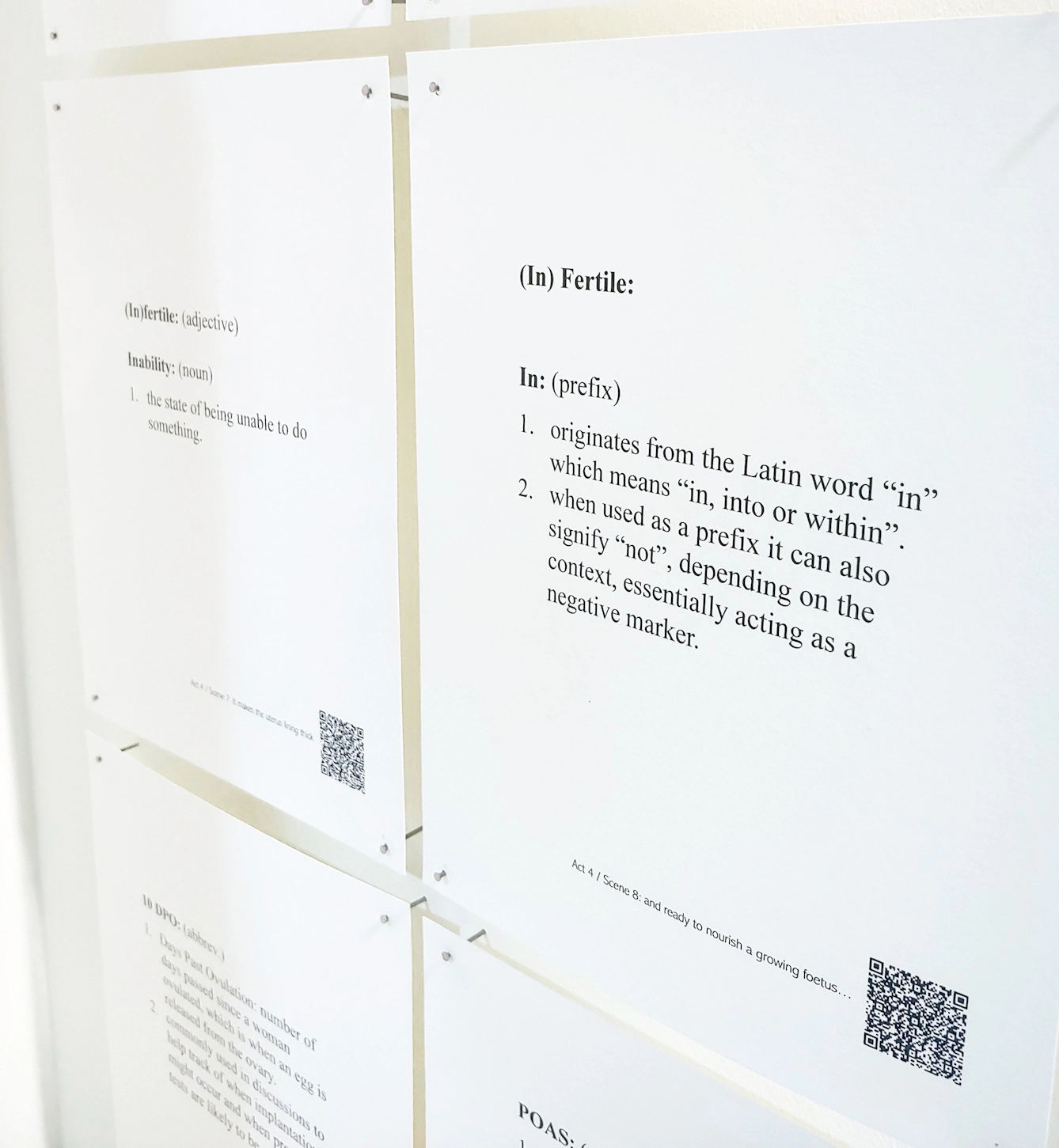
Section of ‘A Glossary With(In)Fertile Terms‘, 2025, Artwork by Sally Butcher. Source: Sally Butcher. © Sally Butcher.
A close up from one of the displays in Sally's artwork 'A Glossary With(In)Fertile Terms', highlighting the negativity inherent in the word infertile.
This ingrained medicalisation belies the fact that much about infertility remains unexplained, and the diagnosis for many women, such as me, is essentially “we don’t know; we can’t see anything; everything is medically normal”. It also focuses on the woman as the one to be ‘cured’, rather than considering wider social factors.
Seeking alternatives online
For my work, I’ve explored how alternative understandings of (in)fertility can manifest in exchanges between women. I was particularly intrigued by women-led online fertility forums as places where women gather. I was interested in how such confessional online spaces break with the social taboos of silenced infertility, offering alternatives (or not) to having those uneasy conversations with family and friends.
I was also interested in broader narratives from my discussions with women who have experienced (in)fertility and articulating my own lived experience. I wanted to discover how words slip in and out of established and medical terminologies as women use online spaces to express their own experiences and emotions, as well as share information to assist others.
Scavenging through history
My research on virtual spaces and digital participation has been counterbalanced by research in the Wellcome Collection historical archives and, as a result, many surprising connections have emerged. Being an artist let loose in the historical collections, I was able to employ a scavenger approach to the collection, picking and choosing the bits that fitted best with my practice.
I was immediately drawn to the medieval birthing girdle introduced to me by Dr Elma Brenner at Wellcome Collection. This historical textual amulet held power in its words to protect a woman in pregnancy and labour. Written on both sides, it was made to be read, believed and bound around the visibly birthing body. Centuries of such interactions with the scroll have left their mark, rubbing away text and images over time.
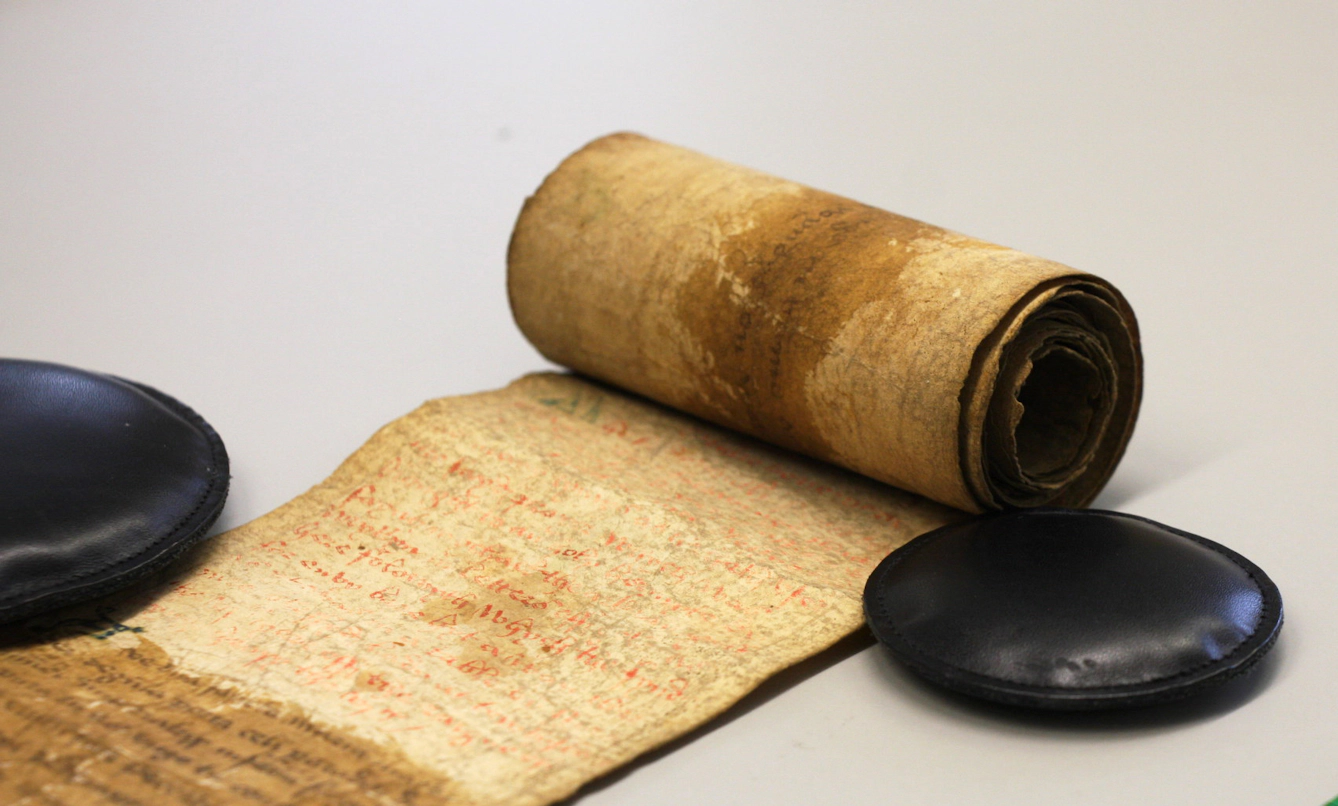
'Birth scroll with prayers and invocations to Saints Quiricus and Julitta', c.1500CE, Photographer: Kierri Price. Source: Kierri Price/Wellcome Collection. © Kierri Price/Wellcome Collection.
Wellcome Collection medieval birth scroll MS.362, 'Birth scroll with prayers and invocations to Saints Quiricus and Julitta', c.1500CE.
By comparison, the (in)fertile body cannot take up the same space and is frequently unable to make any impression with an (un)reproductive condition that is inherently invisible and readily silenced by stigma.
Scrolls and scrolling
The construction of the birth scroll – as a continuous page – straddles some of the oldest and newest ideas about viewing and reading texts, providing a useful parallel to my scrolling through the hypertext of women’s words online. The birth scroll was designed to roll up small, so it could be carried about the person, keeping those reassuring words close when they were needed most. To me, this resonated with the online fertility forum, ever-present on your mobile phone – something to draw on if needed.
I became particularly intrigued by the place of the scroll format within the development of written knowledge construction before the invention of the codex - the early form of bound books. I found parallels with the adoption of the scroll as an anti-patriarchal textual form in 1970s feminist art practice (in the work of Nancy Spero and Carolee Schneeman), a format that wasn’t bound by the rigid order (of meaning) imposed by the book form.
An imaginary archive of in(fertility)
I developed these understandings of medieval knowledge formats alongside other archival research into Wellcome Collection’s later medical dictionaries and glossaries, which revealed how established hierarchies of knowledge have constructed meaning around reproduction. From this I created my own ‘A Glossary With(In)Fertile Terms‘.
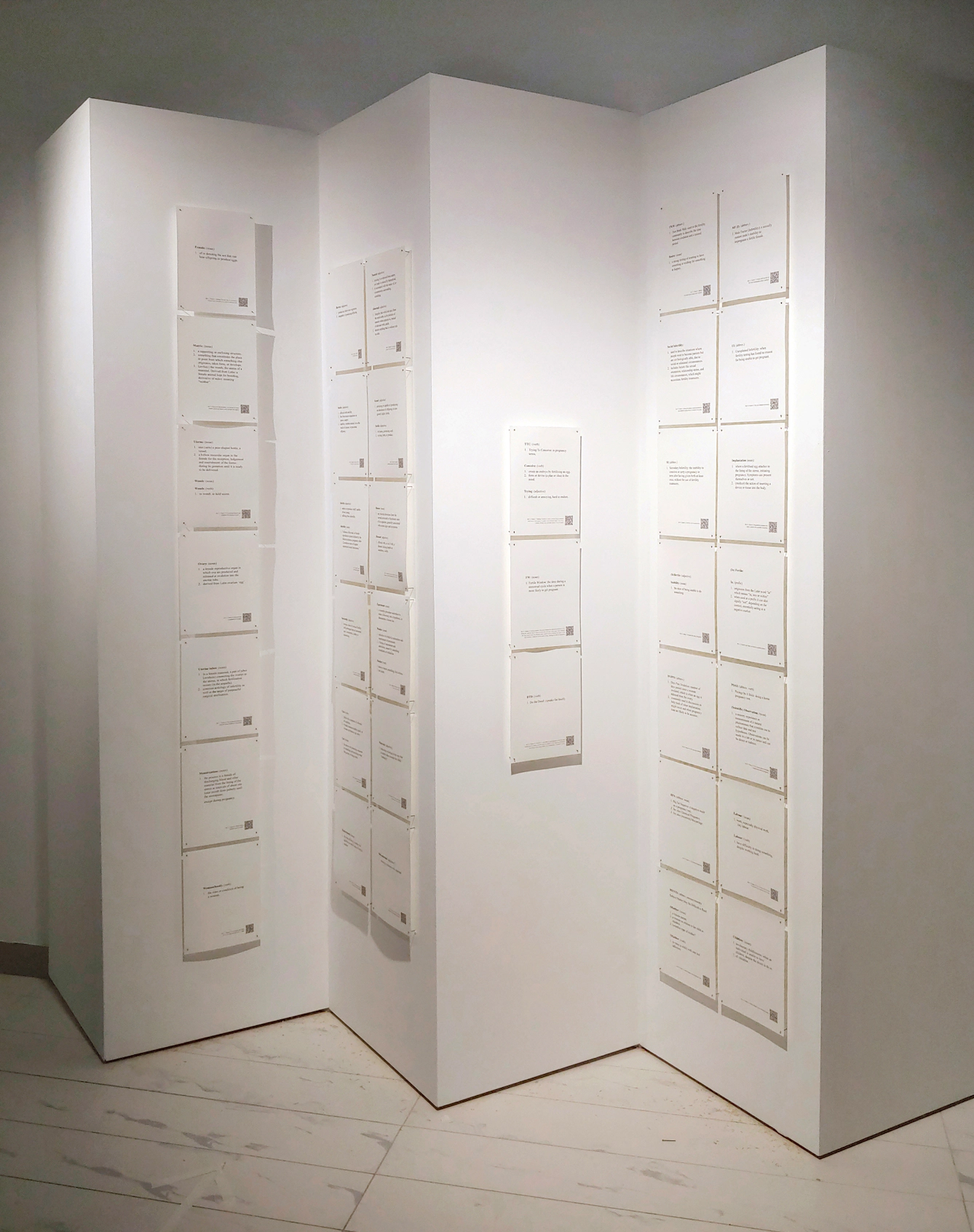
Section of 'A Glossary With(In)Fertile Terms', 2025., Artwork by Sally Butcher. Source: Sally Butcher. © Sally Butcher / Ikon Gallery, Birmingham.
Display panel from an exhibit of 'A Glossary With(In)Fertile Terms' at the Ikon Gallery, showing medicalised and traditional terminology related to infertility.
This artwork is made up of 36 parts in total, spilt into four sections that align with the biological menstrual cycle. So, this ‘Glossary’ unfolds over time, rather than alphabetically, generating an explorative embodied space around the evolution of infertile language.
The whole piece exists in two halves – the visible top layer of the paper ‘Glossary’ and hidden women’s ‘narratives’ underneath. This imaginary archive documents a collective telling of (in)fertile women’s words, constructed from fragments of contributor responses. It attempts to deconstruct medical and maternal hierarchies of knowledge, while making space for voices that are personal, vulnerable, and angry.
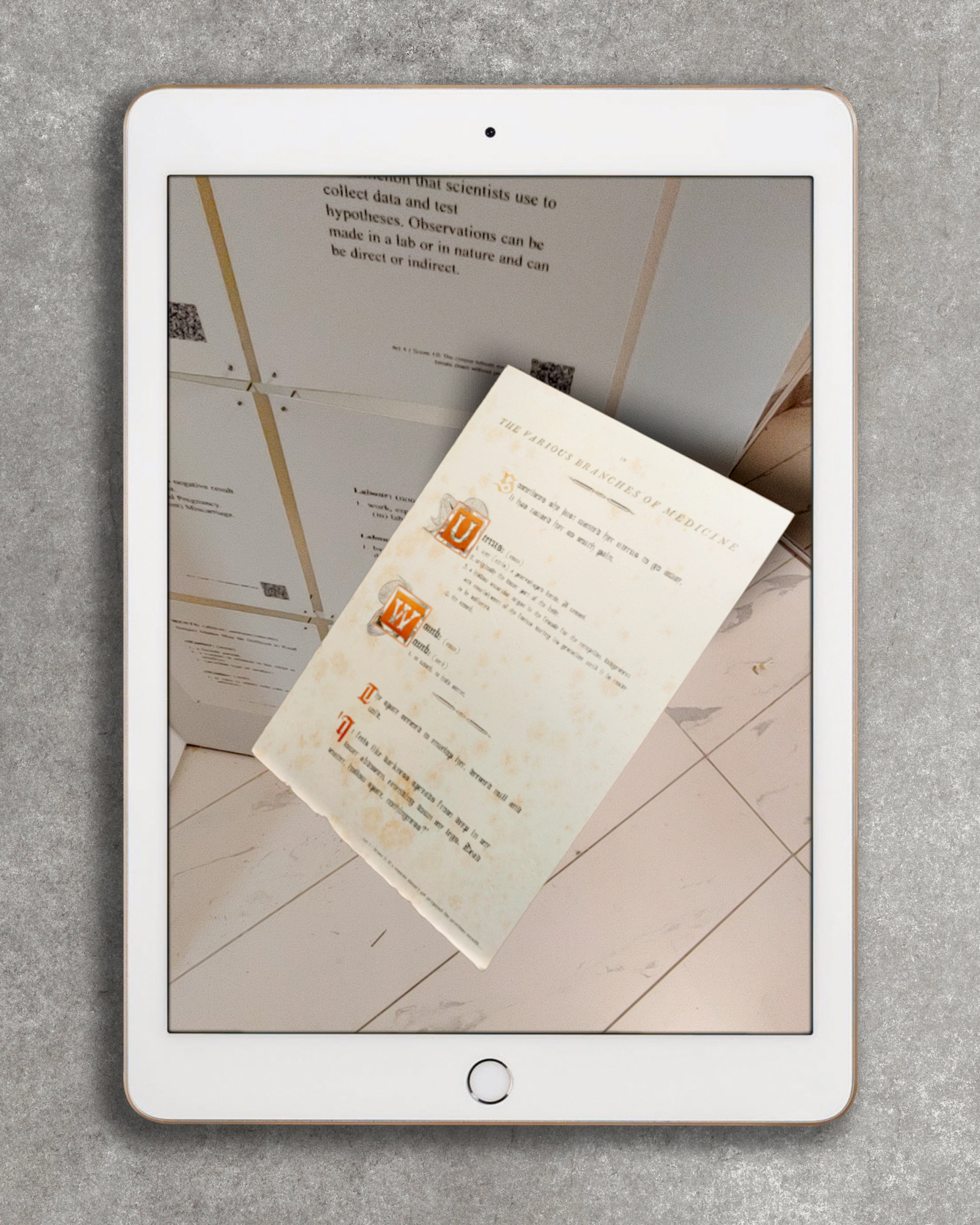
Act 1/Scene 1 of 'A Glossary With(In)Fertile Terms', 2025., Artwork by Sally Butcher. Source: Sally Butcher. © Sally Butcher.
Screen capture of an augmented reality display seen by the viewer when they scan a QR code on the displayed pages. In contrast to the plain text of the 'real' pages the virtual page uses medieval style illuminated lettering.
Integral to my work are transitions between materiality and intangibility. These are inherent in online forums where a real, corporeal body communicates with a virtual, collective body (of knowledge). So, these hidden parts exist only as augmented reality. These digital simulations aren’t actually present but must be generated by viewers using their own mobile phone. A virtual encounter that draws the audience into the themes of absence/presence as metaphors for fertility/infertility.
Words and spaces
In my Glossary I carefully pose ‘official’ historical terms, like ‘barren’ and ‘sterile’, alongside contemporary concepts of social infertility or male-factor infertility, as well as colloquial acronyms and initialisms from the fertility forum, such as TTC – trying to conceive, or FW – fertile window. This digital shorthand compresses meaning into a protective communal code, unreadable by those who don’t know or don’t need to understand. This echoes the medieval birth scroll; though created by patriarchal religious institutions with a particular message, in the all-women Medieval birth chamber its use and meaning was adapted by and for women.
Fragility and reassurance
As a maker, I was drawn to the fragility of the medieval scroll as it appears today. The transfer lettering that I used on parts of my piece was intentionally old and worn (past its fertile age, you might say), vulnerable to harm as my hands wore away the text while I constructed it.
The birth scroll was meant to be regularly touched as well as read, fingertips rubbing the words and images on the scroll’s surface as they moved rhythmically through different passages to gain the protection promised by the manuscript. This feels like the regular checking of text in the online forum, readily scrolling through a continuous page of information, searching others’ words for reassuring support during a difficult and often lonely time.
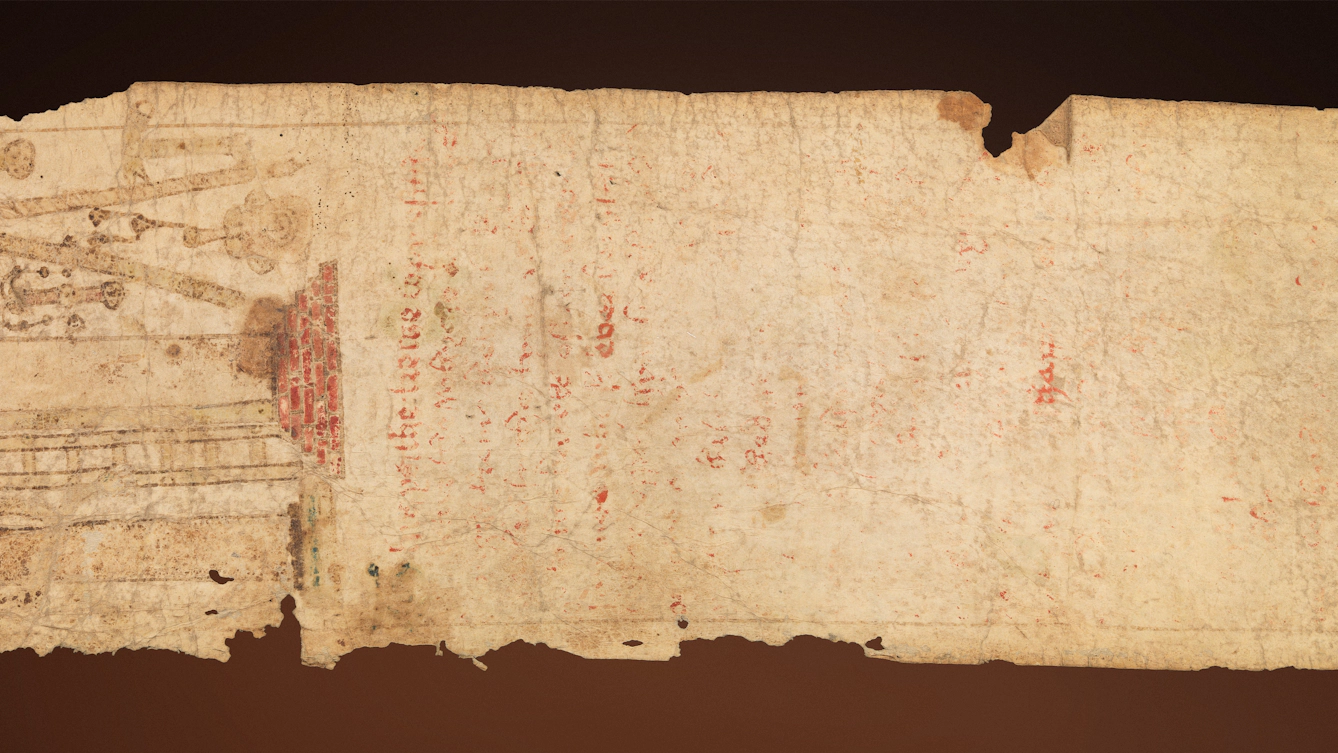
'Birth scroll with prayers and invocations to Saints Quiricus and Julitta', c.1500CE, Photographer:. Source: Wellcome Collection. Public Domain Mark.
A detail from the very fragile medieval birth scroll MS.362. The text on sections of the parchment scroll has faded to the point of invisibility as a result of centuries of rubbing by hands in prayer and from being wrapped around women in childbirth.
Other parts of my piece appear on scrolls of redundant dot-matrix paper that look like the output from a contemporary medical machine measuring foetal movements inside a woman’s body. Instead, I fill the scrolling paper with textual markings that hint at the absence within an (in)fertile women’s medicalised experience.
Economies of re(production)
Unlike the parchment birth scroll, which is imbued with religious authority and communal support, parts my ‘Glossary’ are made with receipt rolls, weighted now with (in)fertility’s connotations of individual production, value and worth. In the search for answers and treatment, people often feel obliged to invest in a new economy of reproduction, balancing the financial cost of treatment against the emotional cycle of hope and disappointment.
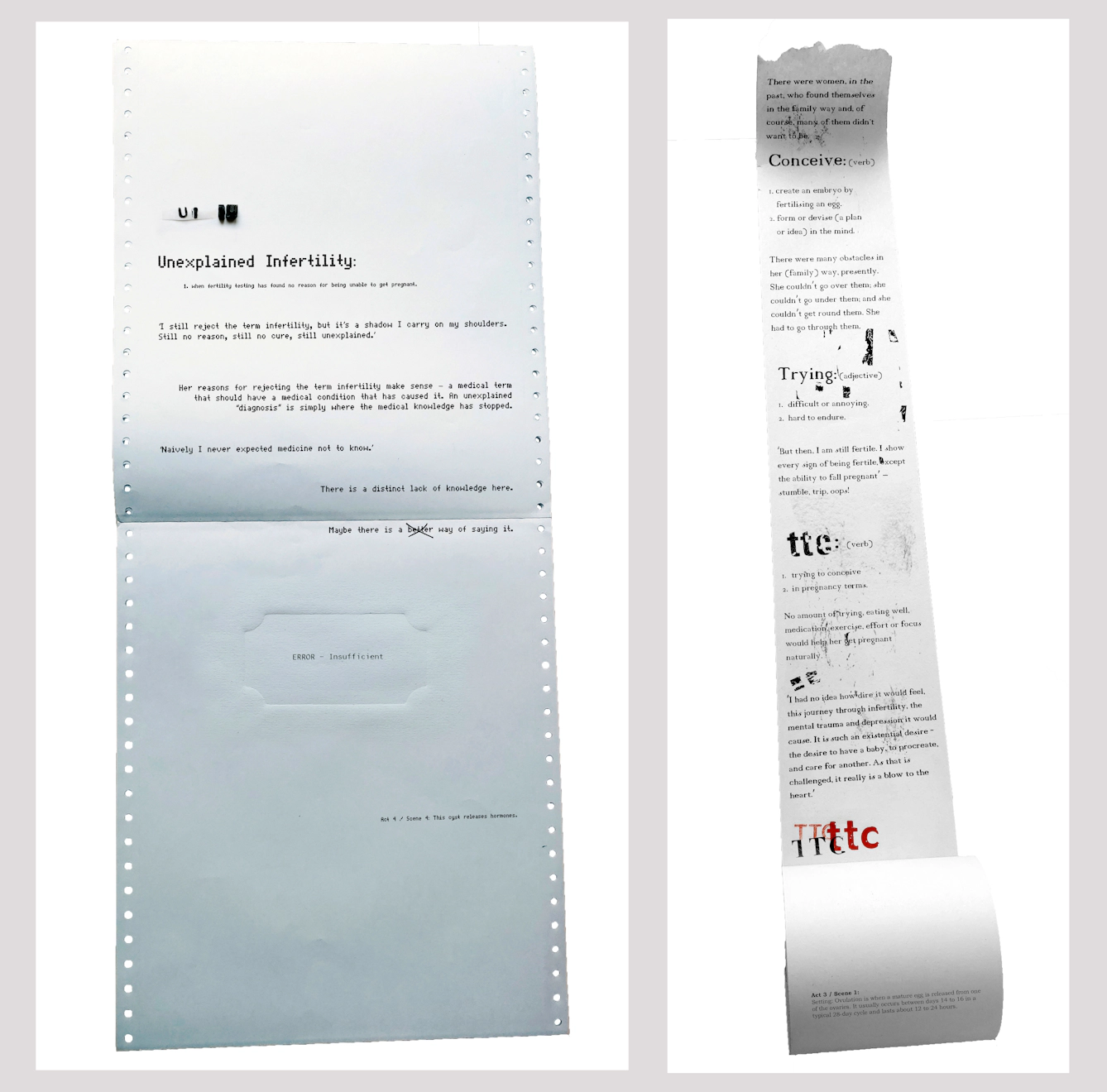
Act 3/Scene 1 (right) and Act 4/Scene 12 (left) from 'A Glossary With(In)Fertile Terms' both reference scrolls and scrolling. The computer printout refers to continuously scrolling medical data and the till roll refers to the economies of reproduction and infertility.
Women’s experiences are easily lost within the biomedical science of modern (in)fertility, but the medieval birth scroll is a reminder of something else that is equally important. It is a real vessel carrying something intangible – prayers and support for pregnant women.
Perhaps the virtual ‘baby dust’ scattered through online forums performs a similar role for women dealing with (in)fertility. Conversations with phrases such as “sending you baby dust” encapsulate real spaces of belief in hope and luck for a good outcome. One key thing common to both medieval birth scrolls 21st-century online (in)fertility forums is the importance of communal support between women during challenging times.
Acknowledgment
Sally Butcher would like to acknowledge the labour of all the women who contributed to this collective artwork, without whom it would not exist.
About the author

Sally Butcher
Sally is an artist and doctoral researcher, completing her practice-led PhD: '(In) Fertile Embodiment: Revealing the Traces of Infertility between the Medical and Maternal through Feminist Art Practice' (across Birmingham City University School of Art and De Montfort University Centre for Reproduction Research, with a placement at the Wellcome Collection).