Experiments in plant hybridisation / Mendel's original paper in English translation, with commentary and assessment by Sir Ronald A. Fisher, together with a reprint of W. Bateson's biographical notice of Mendel ; edited by J.H. Bennett.
- Mendel, Gregor, 1822-1884. Versuche über Pflanzenhybriden. English
- Date:
- [1965]
Licence: Attribution-NonCommercial-NoDerivatives 4.0 International (CC BY-NC-ND 4.0)
Credit: Experiments in plant hybridisation / Mendel's original paper in English translation, with commentary and assessment by Sir Ronald A. Fisher, together with a reprint of W. Bateson's biographical notice of Mendel ; edited by J.H. Bennett. Source: Wellcome Collection.
49/116 (page 35)
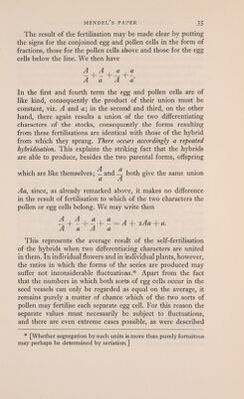
![Mendel's paper 35 The result of the fertilisation may be made clear by putting the signs for the conjoined egg and pollen cells in the form of fractions, those for the pollen cells above and those for the egg cells below the line. We then have Л.А a a A^a + In the first and fourth term the egg and pollen cells are of like kind, consequently the product of their union must be constant, viz. A and a; in the second and third, on the other hand, there again results a union of the two differentiating characters of the stocks, consequently the forms resulting from these fertilisations are identical with those of the hybrid from which they sprang. There occurs accordingly a repeated hybridisation. This explains the striking fact that the hybrids are able to produce, besides the two parental forms, offspring A a . which are like themselves ; _ and — both give the same union a A Aa, since, as already remarked above, it makes no difference in the result of fertilisation to which of the two characters the pollen or egg cells belong. We may write then A . A , a , a . , . . ^ + + a. A a A a This represents the average result of the self-fertilisation of the hybrids when two differentiating characters are united in them. In individual flowers and in individual plants, however, the ratios in which the forms of the series are produced may suffer not inconsiderable fluctuations.* Apart from the fact that the numbers in which both sorts of egg cells occur in the seed vessels can only be regarded as equal on the average, it remains purely a matter of chance which of the two sorts of pollen may fertilise each separate egg cell. For this reason the separate values must necessarily be subject to fluctuations, and there are even extreme cases possible, as were described * [Whether segregation by such units is more than purely fortuitous may perhaps be determined by seriation.]](https://iiif.wellcomecollection.org/image/b18033131_0050.JP2/full/800%2C/0/default.jpg)