Note on the nature of the parasitic bodies found in tropical splenomegaly / by W.B. Leishman.
- Leishman, W. B. (William Boog), Sir, 1865-1926.
- Date:
- 1904
Licence: Public Domain Mark
Credit: Note on the nature of the parasitic bodies found in tropical splenomegaly / by W.B. Leishman. Source: Wellcome Collection.
3/4
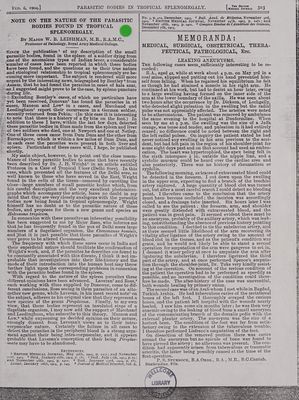
![FER. 6, 1904. | Tee Barri laos avaske 393 NOTE ON THE NATURE OF THE PARASITIC BODIES FOUND IN TROPICAL SPLENOMEGALY. By Masor W. B. LEISHMAN, M.B., R.A.M.C., Professor of Pathology, Royal Army Medical College. Since the publication’ of my description of the small parasitic bodies, found in the spleen of a soldier dying from one of the anomalous types of Indian fever, a considerable -‘mumber of cases have been reported in which these bodies _ have been found, and the questions as to their true nature _and etiological relationship to tropical splenomegaly are be- ‘coming more important. The subject is rendered still more argent by the interesting news, telegraphed by Bentley ? from Assan, that he had found the parasites in cases of kala azar, -sas I suggested might prove to be the case, by spleno-puncture during life. — nat MBL ; Excluding Bentley’s cases, of which no particulars have “syet been received, Donovan* has found the parasites in 16 «cases, Manson and Low‘ in 2 cases, and Marchand -and _ Leedingham’ report. their occurrence ina German soldier, recently returned from Pekin: -(In~ this case it is interesting ‘to note that there is a history of a fly bite on the foot.) In _ addition to these I have;-within the last few days, detected ~ these parasitic bodies in films made from the spleen and liver of two soldiers who died, one at Newport and one at Netley. ‘One of these cases came from Dum Dum and the other from « Barrackpore, which is within a few miles of Dum Dum, and » spleen. Particulars of these cases will, I hope, be published = Shortly. _ My main object, however, is to point out’ the close resem- blance of these parasitic bodies to some that have recently been described by Dr. J. H. Wright® in an article entitled Protozoa in a Case of Tropical Ulcer (Delhi Sore). In this <ase, which presented all the features of the Delhi sore, so well known to those who have served in the East, Wright found in the cells of the tissue—removed by curetting the ulcer—large numbers of small parasitic bodies which, from his careful description and the very excellent photomicro- graphs which accompany the article, leave no deubt in my mind that they are very closely analogous with the parasitic Sodies now being found in tropical splenomegaly. Wright himself-has no doubt as to the parasitic nature of these Sodies, and proposes for them a new genus and species as delcosoma tropicum. In connexion with these parasites an interesting possibility has been suggested to me by Major Ross, who informs me that he has frequently found in the pus of Delhi sores large numbers of a flagellated organism, the Cercomanas hominis, and jthat it is just possible that these parasites of Wright’s may prove to be altered Cercomonads. The frequency with which these sores occur in India and their superficial nature should facilitate the confirmation of Wright’s work, and, if the parasites he describes are found to be constantly associated with this disease, I think it not im- probable that investigations into their life-history and the ‘mode of their introduction into the human host may throw further light upon the corresponding problems in connexion with the parasitic bodies found in the spleen. | With regard to the nature of the spleen parasites three -<different opinions have been advanced. lLaveran’7 and Ross,?® ‘each working with films supplied by Donovan, come to dif- ferent conclusions, Ross seeing in them parasites of an alto- - gether new genus, while Laveran, in his most recent note’ on the subject, adheres to his original view that they represent a new species of the genus Piroplasma. TY inally, to my own “view, that these bodies represent an involuted stage of a dagellate organism, [ may now add the support of Marchand and Leedingham, who subscribe to this theory. Manson and Low.* while expressing no decided opinion on their nature, strongly dissent from Laveran’s views as to their intra- ‘<orpuscular nature. Certainly the failure in all cases to -detect the parasites in the peripheral blood is a strong argu- “ment against their being intra-corpuscular, and it appears probable that Laveran’s conception of their being Piroplas- ~anata may have to be abandoned. No. 3, D. 472, December, 1903. 7 Bull. Acad. de Médecine, November 3rd, 1903. 8 BRITISH MEDICAL JOURNAL, November 14th.. 1903, p. 1261; and ovember 28th, 1903, p.xzg01. *® Comptes Rendus de lV Académie des Sciences, December 7th, 1903. MEMORANDA: MEDICAL, SURGICAL, OBSTETRICAL, THERA- PEUTICAL, PATHOLOGICAL, Ero. LEAKING ANEURYSMS. THE following cases seem_ sufficiently interesting to be re- corded: ts R.A., aged 42, while at work about 4 p.m.on May 3rd in a coal mine, slipped and putting out his hand prevented him- self from falling. When he regained his equilibrium. he felt as though he had strained a muscle in his right arm. He continued at his work, but had to desist an hour later, owing toa large swelling having formed on the inner side of the arm at the lower boundary of the axilla. He was seen about two hours after the occurrence by Dr. Dickson, of Lochgelly, who detected slight pulsation in the swelling but the radial pulse was not appreciably affected. The arteries were noted to be atheromatous:: The patient was removed by ambulance the same evening to the hospital at Dunfermline. When seen by me at 9g p.m. the swelling was the size of a Jaffa orange, was tense and tender, and pulsation in it had entirely ceased; no difference could be noted between the right and the left radial pulses. On inquiry the patient stated he had never noticed any swelling in his arm previous to the acci- dent, but had felt pain in the region of his shoulder-joint for some eight days past and on that account had used an embro- cation. The heart was hypertrophied, the apex being felt in the sixth interspace 3} in. outside the nippie line, and a systolic murmur could be heard over the cardiac area and also posteriorly. There was no history of rheumatism or syphilis. The following morning, as traces of extravasated blood could be detected in the forearm, I cut down upon the sweiling in the upper arm, expecting to find a branch of the brachial artery ruptured. A large quantity of blood clot was turned out, but after a most careful search I could detect no bleeding point. Itherefore came to the conclusion that the artery must have become occluded; the incision was accordingly closed, and a drainage tube inserted. Six hours later I was called to see the patient; the forearm, arm, and shoulder were greatly distended with extravasated blood, and the patient was in great pain. It seemed evident there must be an aneurysm, probably of the axillary artery, which was leak- ing, notwithstanding the absence of previous history pointing to this condition. I decided to tie the subclavian artery, and as there seemed little likelihood of the arm recovering its vitality after ligature of the artery owing to the amount of blood clot in the tissues, and as the patient’s condition was grave, and he would not likely be able to stand a second operation for amputation of the arm were gangrene to set in, I deemed it wiser policy at once to amputate the arm after ligaturing the subclavian. I therefore ligatured the third part of the artery, and at once performed Spence’s amputa- tion through the shoulder-joint, Dr. Tuke very kindly assist- ing at the operation. On account of the serious condition of the patient the operation had to be performed as speedily as possible, and no investigation of the condition could there- fore be made. The after-history of the case was uneventful, both wounds healing by primary union. ; -- The second case was ofan Arab whom I met whilein Bagdad, bones of the left foot. I thoroughly seraped the carious bones, and the patient left hospital with the wounds nearly healed. I saw him some six months later; he was then very anaemic owing to the leaking of blood from a smal] aneurysm of the communicating branch of the dorsalis pedis with ihe external plantar artery. The aneurysm was the size of a haricot bean. The condition of the foot was far from satis- factory owing to the extension of the tuberculous trouble. I therefore performed Lisfranc’s amputation of the foot. On dissection of the removed portion there was caries around the aneurysm but no-spicule of bone was found to have pierced the artery; no atheroma was present. The con- dition had apparently arisen from tuberculous or traumatic arteritis, the latter being possibly caused at the time of the first operation. P.S. Sturrock, B.A.Oxon., B.A., M.B., B.C.Cantab. Dunfermline, Fife. vA \WCOp Sie | LIBRARY I Ni te aa mE 2 issn hebrestere ober eigeadtaetahaaedate sre Ras canoe sa Saghaged ddlep tne devel ant ahas dan Pipeahe, Ae GPa mache aoe dantntais texte ctalael aaa aL oeh, «Cok Shetek, eek te dh tania ae ohn al ile i oe =e. oom phe 4 pee Ho try =BaPS fhe py crea eT Esper a. tw tA, aay soars = eae Serr](https://iiif.wellcomecollection.org/image/b33455296_0003.jp2/full/800%2C/0/default.jpg)